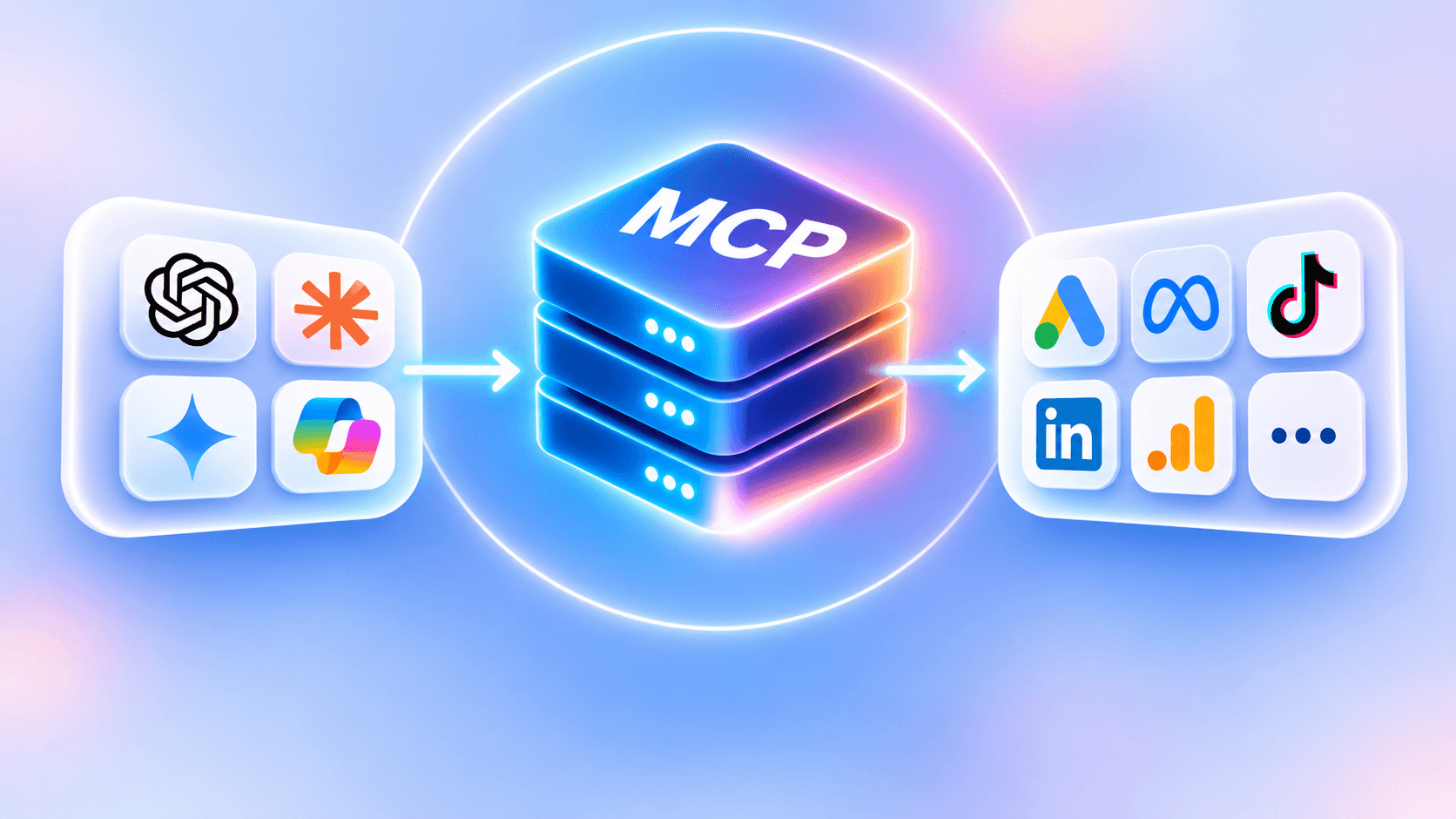
MCP (Model Context Protocol) is an open standard that lets an AI assistant such as Claude or ChatGPT call outside tools: read a Google Ads account, query GA4, change a budget. It supplies neither the data nor the safeguards: what the assistant sees and can do depends entirely on the server you connect.
Where MCP comes from
Anthropic, the company behind Claude, released the protocol on November 25, 2024, as an open standard for connecting AI assistants to the systems where data lives. The idea is modest: an MCP server written once works with every assistant that speaks the protocol, instead of one integration per assistant.
On December 9, 2025, Anthropic handed MCP to the Agentic AI Foundation, a directed fund under the Linux Foundation co-founded with Block and OpenAI: the protocol no longer belongs to a single vendor. Anthropic said at the time that ChatGPT, Cursor, Gemini, Microsoft Copilot and Visual Studio Code had adopted it.
For an advertiser, the practical consequence is simple. The question is no longer "can my assistant read Google Ads?" but "which MCP server gives it access to Google Ads, and with which rights?"
Three parts: the assistant, the server, the tools
Take an ordinary question asked to Claude: "Which Google Ads campaigns spent without converting last week?"
- The assistant (Claude, ChatGPT, Cursor) reads the question. It does not know your account: it only knows the list of tools the connected servers have announced, with their descriptions.
- The MCP server is the program that connects to Google Ads. It holds the access to the account and publishes its tools: list campaigns, read their results over a period, sometimes change a budget.
- The tools are the precise actions the server accepts. The assistant picks which one to call, with which parameters (the account, the dates), receives the result, then writes its answer.
The specification also provides resources (data made available to the assistant or the user) and message templates prepared by the server. In advertising, tools are what matter most.
A comparison helps: MCP is the power socket, not the appliance. A standard socket lets you plug in any toaster; it tells you nothing about what the toaster does or how much power it draws. In the same way, two MCP servers for Google Ads may share nothing but the protocol: one reads three reports, the other can delete campaigns.
What MCP does not do
This is the part enthusiastic introductions skip.
MCP does not choose the data. If the server only returns spend and clicks, the assistant has no conversions, and it will say so, or worse, fill the gap with a guess. The quality of the answer depends on what the server exposes.
MCP does not check the numbers. A CPA read in Google Ads and another read in Meta are not measured the same way (windows, attribution models). The protocol carries the numbers; it does not make them comparable. If the assistant adds them up carelessly, the answer is wrong and very confident.
MCP does not protect your account on its own. The server's scope is the scope of possible damage. A server with admin rights and a delete tool lets the assistant delete, whether you meant it to or not. Safeguards (read-only, one change at a time, a log of calls) are choices made by the server, not by the protocol.
MCP does not filter what the assistant reads. A campaign name or an ad text can contain a sentence the model will take as an instruction. This risk, called indirect injection, exists as soon as an assistant reads content it did not write. The safest protection is still a server with no write tools when you do not need them.
The guide to an MCP server for Google Ads details these safeguards for anyone building one.
Connecting an ad platform today: three situations
As of November 19, 2026, three situations coexist.
- The platform's official server, self-hosted. This is the case for Google Ads: Google publishes a server you install on your own machine or on Google Cloud, with a Google Cloud project and Python. According to its documentation, it reads the account, creates assets and manages labels, but does not change campaigns, budgets or bids. Doable for a technical team, rarely for a performance marketer on their own.
- The platform's official server, hosted by the platform. Meta offers a server for its ads, hosted by Meta, in open beta since April 29, 2026, according to our review of its official pages. You add it to the assistant by its address. It covers Meta, and only Meta.
- A server that brings several platforms together. One address to add, several accounts behind it. Several vendors do this, including us with Pilot MCP.
The comparison of advertising MCP servers puts twelve offers side by side, on the same criteria, based on their official pages.
Before connecting an account, four questions
Whatever the server, ask them before granting access.
- Read-only, or write? Start with read. Check over a few weeks that the analyses hold up before letting the assistant touch a budget.
- Which accounts? An agency access often sees dozens of client accounts. The server should limit the assistant to the ones you chose.
- Who keeps the access to the ad platform? Ideally the server keeps it and never passes it on to the assistant.
- Where are calls logged? Without a log, an unexpected change cannot be explained afterwards.
Where Pilot fits
Pilot Ads by Braike is an AI copilot for paid media, with its own application. Pilot MCP is a separate offer: it connects the accounts of a Pilot workspace to ChatGPT, Claude, Cursor or another MCP-compatible assistant, across 28 platforms including Google Ads, Meta, TikTok, LinkedIn Ads and Google Analytics, with Pilot's business skills.
The Free plan covers one ad account, read-only, with no credit card and no time limit. At €29 excl. VAT per person per month, the assistant acts on every account in the workspace: it creates, edits, pauses and deletes, one object at a time, and Pilot reads the object before and after each change and logs every call. The details are on the Pilot MCP security page.
Frequently asked questions
Is MCP an AI? No. It is a protocol, a standard way for an AI assistant to call tools. The intelligence is in the model; the access to data is in the server.
Do I need to code to use MCP? To build your own server, yes. To add a hosted server to Claude or ChatGPT, no: you paste an address or install a plugin, then grant access.
Does an MCP server see the numbers at the moment of the question? It depends on the server. Some tools query the platform when called, others read data collected the day before. A good answer says how old its numbers are.
Does MCP replace reporting connectors? Not for regular reporting that is identical every week: a classic integration is simpler and cheaper. MCP is useful when the question changes every time.
To try it on your own account, Pilot MCP is free on one ad account, with no credit card.
Sources
- Introducing the Model Context ProtocolAnthropic · November 25, 2024
- Donating the Model Context Protocol and establishing the Agentic AI FoundationAnthropic · December 9, 2025
- SpecificationModel Context Protocol · July 28, 2026
- Google Ads MCP server (developer documentation)Google · November 19, 2026
- googleads/google-ads-mcp (GitHub)Google · November 2, 2026
- Serveurs MCP publicitaires : le comparatifPilot Ads by Braike · October 21, 2026
Facts checked on November 19, 2026.
Written by
Edris Paikan
CTO at Braike